by Rev Fr Fabian Dicom
Apocalypse 7:2-4,9-14
Psalm 23:1-6
1 John 3:1-3
Matthew 5:1-12a
Theme: Grief, Comfort & Reward
Today, heaven and earth meet. The Feast of All Saints is not a nostalgic glance at the gallery of perfect people in stained glass or statues. It is a daring celebration of the unfinished symphony of holiness.
God’s dream is still being written in the trembling hands, the broken hearts and the dusty feet of people like us.
The Book of Revelation opens a window into this mystery. The First Reading. We hear ‘I saw a huge number, impossible to count, of people from every nation, race, tribe and language.‘ Notice, no one could count them.
Holiness is not a private club for the canonised few. It is a multitude beyond measure, a movement, an uprising of grace. The saints are not exceptions to humanity. They are humanity fully alive.
And when we celebrate All Saints, we are not just remembering them. we are being reminded of who we are truly.
As John says, ‘Think of the love that the Father has lavished on us (in the Second Reading) by letting us be called God’s children.‘ And that is what we are.
This Feast is not about admiring saints from afar. It is about awakening the saint within. Within.
And how does Jesus describe this holiness? Not with halos or miracles but with a strange and subversive poetry – The Beatitudes. Beatitudes of what we know so well:-
Blessed are the poor in spirit.
The meek.
Those who hunger and thirst for justice.
Each line is a counter melody to the world’s song of success. Each blessing overturns the world’s logic.
If you listen carefully, the beatitudes are not moral instructions but revelations, glimpses into the very heart of God. They reveal what God blesses and where God is found. God is not found in the centers of power, wealth or acclaim, but in the margins where people still hunger for righteousness, where people cry and shed for love, where mercy becomes a quiet rebellion.
Holiness then is not about rising above the world. It is about descending into the pain with compassion. It is not separation from the world but solidarity with its wounds.
Saints are not people who escaped the struggle. They are people who entered it deeply and came out radiant with love.
Richard Rohr even says saints are people who have been healed.
The Book of Revelation says this:
These are the people who have been through great persecution.
Now the original text of scripture which is in Greek suggests that this ‘great persecution‘ does not refer to one single persecution in history. Rather it points to every kind of suffering that tests the human heart – the trails, the losses, the wounds through which faith is refined.
So who are these people today? Who are these people?
They are the mothers who keep their families together through silent courage.
The refugees who sing songs of hope across barbed wires.
The activists who hold banners for justice when no one claps.
The elderly who prayed quietly for a world they no longer understand.
The children who still believe the world can be kind.
They are the saints of the ordinary. The anonymous multitude dressed not in white robes but in the dust of daily fidelity. They are the blessed of the Beatitudes who may never be canonised but whose names are written on the heart of God.
My dear brothers and sisters, for too long we have turned sanctity into a museum for moral perfection. But the Gospel invites us to something far more daring. A holiness that is not flawless but fearless.
To be a saint today is:-
To live with open eyes and a courageous heart,
To stand firm when truth is ridiculed, to speak peace in a culture that glorifies aggression,
To hope when despair feels more logical,
To love when hatred shouts the loudest,
To forgive even when it costs our pride.
This is the holiness that does not retreat from the world but walks right into its darkness, carrying the light of Christ. It is not a holiness of perfection but of daring. Daring to believe that love is stronger than fear and mercy more powerful than judgment.
Saints are the living poetry of God’s compassion in an ordinary world. They show us what matters most. It is not success or recognition but the courage to love when love costs us something.
Pope Francis says in his apostolic exhortation on the call to holiness in the world. He says,
Holiness is the most attractive face of the church. It is what draws hearts not power or perfection but the quiet beauty of lives made luminous by love.
The early Christians from all that we have read, from the Bible as well as from the early history of the church. The early Christians saw holiness as a kind of radiance. Not something to boast of but something that shines naturally, spreading warmth and light to everyone it touches.
Think of those whose presence brightens the room, who carry peace, who listen with the soul, who kindle hope simply by being there. That is holiness. The gentle light of God reflected through human lives.
So my dear brothers and sisters, Feast of All Saints calls us to let that light shine, to live as others can glimpse through us the tenderness of God made visible.
And perhaps the most radical message today, in the communion of saints the margin becomes the center. The great multitude John saw was not made up of emperors or priests but those who suffered, who endured, who loved in secret.
Heaven’s geography is upside down.
What the world discards, God crowns.
What the world calls failure, God names fidelity.
What the world calls foolish, God calls blessed.
So when we gather at this altar, we are not escaping the world. We are reclaiming it for God. Here, heaven leans close to earth. Here the saints are not far away. They are woven into our communion, surrounding us with their faith and whispering, ‘Do not be afraid. What you are becoming, we once were. What we are now, you can be.‘
And in this Eucharist, the boundaries of time and space dissolve. we join the great multitude in the song of the Lamb where all divisions fade in the light of divine love.
Saint John continues to say that when it is revealed, we shall be like Him because we shall see Him as He really is. That vision of God is not only our future. It is already breaking into our present. To see God as He is means to see the world as God sees – with compassion instead of condemnation, with wonder instead of weariness.
When we see as God sees, we begin to live as saints live. Not by escaping the world, but by loving it fiercely, tenderly and truthfully.
To be a saint is to recognise the divine spark even in the broken, even in the excluded, even in the forgotten and to kneel before it in reverence.
Imagine standing before a mirror, not one that flatters but the one that reveals truth. You see not your flaws but your belovedness, not past mistakes, but your capacity for light. You see what God sees – a child of the Beatitudes, a saint in the making, part of the great multitude no one can number. That is what you see. That is the mirror this Feast holds before us.
It does not say admire the saints. It says join them.
It does not say they are special. It says so are you.
The Feast of All Saints is God’s wild declaration that the world is still redeemable. It is the celebration of hope that refuses to die. It is the reminder that holiness is not about being outwardly or otherworldly. It is about being deeply human, filled with divine compassion.
So today, let us walk out of this church not merely imitating the saints but continuing their work to turn tears into compassion, wounds into wisdom and ordinary lives, our ordinary lives, into sacred stories. Because the saints are not only in heaven, they are in our midst. They are in us. And heaven, my friends, is still being built in your hands, in your hearts and in this moment, now.
Amen.
Click below to listen to homily and watch video
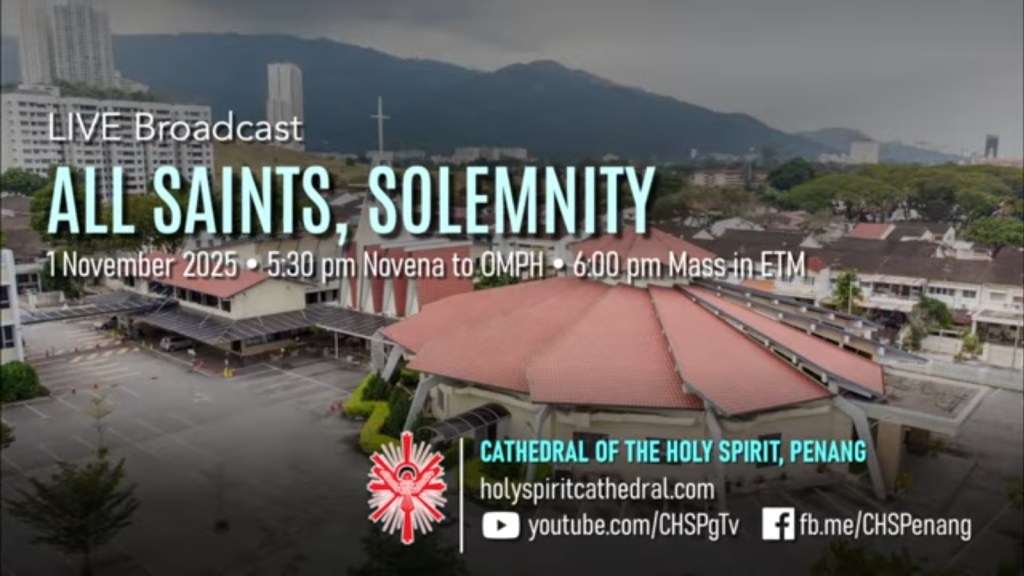
Click to live-stream Mass on 01 November 2025